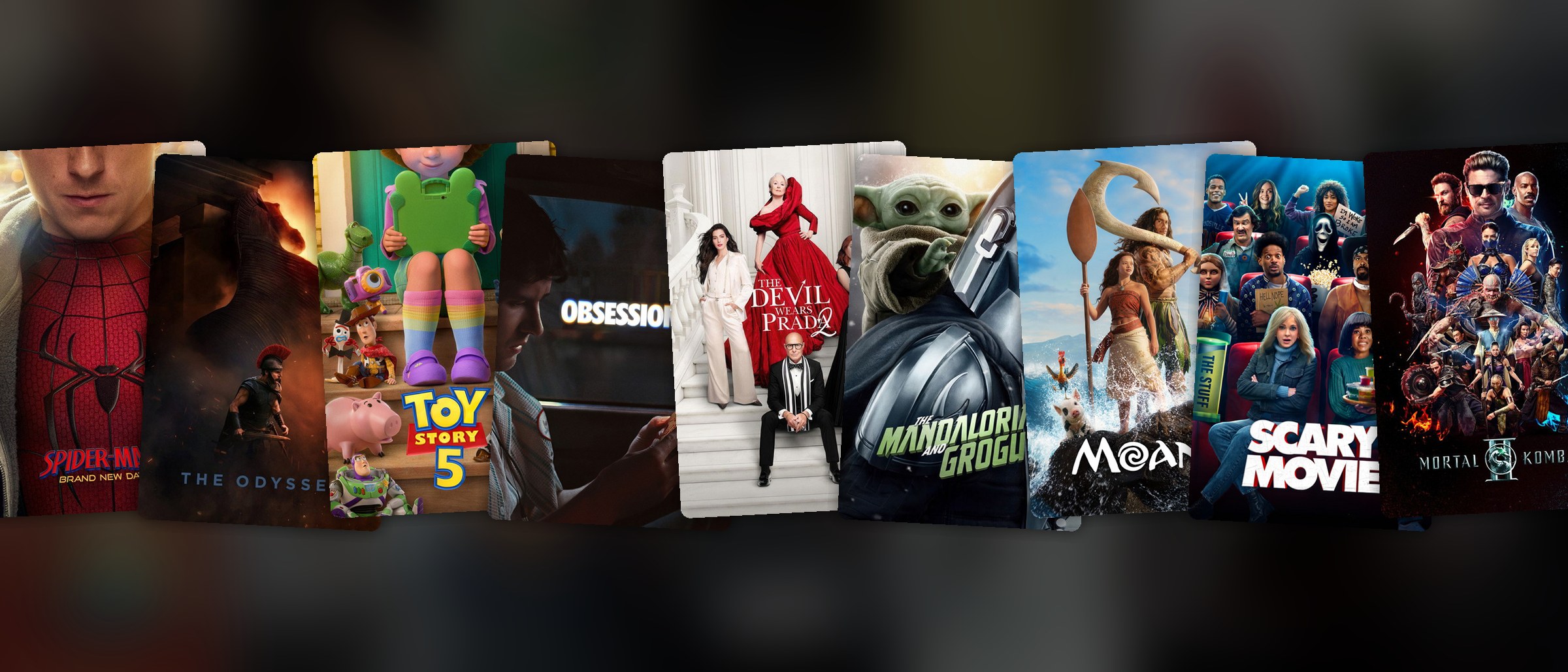
Summer 2026 is the biggest domestic season since 2019, and even has a shot at the all-time record still. Through August 13, the domestic market has taken $4.036 billion, 23.1% ahead of the same fifteen frames last summer ($3.278 billion) and even slightly ahead of 2018 ($3.932B) and 2019 ($3.866B) pre-covid.
At the top, is of course Spider-Man: Brand New Day, banking over $850M already on its way to over $900M by the end of the summer. It accounts for approx 18% of everything the entire market sold this summer. Subtract it and the season sits at $3.32 billion, which is 1.3% ahead of summer 2025.
We’ll recap in detail below but at a glance: May and June were fine to good. Then July, for its first few frames, was the weakest July in a long time (not including covid). Then The Odyssey started a resurgence, and one week later Spider-Man helped the market post the biggest single week it has ever recorded. That led to the biggest July on record, and those two films are propelling August to a record finish too.
Basically: this Summer was shaping up to be on par with the last two years until The Odyssey and Spider-Man came along, giving the back half a huge leg-up that has put 2026 ahead of anything we’ve seen post-covid and in contention with 2018/2019.
Let’s take a look at some of the biggest hits, the biggest flops, and which studios came out on top, and on the bottom, of Summer 2026.
A frame is one Friday–Thursday week, assigned to the month its Friday falls in. Frames are matched year to year from the first frame beginning on or after May 1, so every season above is measured over the same fifteen weeks of runway. Our frame-summed season totals land within about 1% of the Rentrak figures the trades cite.
The ten films that decided the summer
Ranked on what each one achieved against what was possible for it, not on gross.
WinnersThe five that defined the season

Spider-Man: Brand New Day
Putting this at number one is not a very hard decision... and kinda obvious. Nothing has ever opened bigger, and only one film has ever grossed more domestically than it already has. The record ledger, in order: biggest preview night ever at $72M, biggest opening day ever at $169.8M, biggest opening weekend ever at $360.1M past Endgame’s $357.1M, biggest single marketplace weekend ever at $437.1M for all films, and the fastest film in history to $400M, to $500M and to $800M, in four days, seven and nineteen.
The second weekend fell 60%, steep but completely normal off a record that size, and then the third fell only 51%, a better hold than Endgame managed at the same stage and the second-largest third weekend any film has ever posted. The fourth dropped 45%. These are strong holds that set it up for a run deep into September. As for where it ends up: our model has it finishing at $906.9–981.8M on 2.62x legs, and we’re expecting the top half of that, meaning it should clear The Force Awakens’ $936.7M for the biggest domestic run in history, along with around $2.5B worldwide, the third biggest of all-time.
Sony’s box office grosses for this franchise have just gotten bigger and bigger. Homecoming got to $328M domestic and $878M worldwide. Far From Home increased on that to $391M and $1.13B, and then No Way Home blew them both out of the water with over $800M domestic and $1.92B worldwide. It would have been understandable for this latest one to come down somewhat from those levels but instead, the upward climb continued to stratospheric levels. The verdict is in: people LOVE Tom Holland’s Spider-Man, and this has cemented Spider-Man as the most popular comic book character of all time. Sony will likely never let the rights revert back to Marvel/Disney here: they spent $225M and got the biggest release in the history of the company.

Obsession
The best result of the summer by every measure that isn’t gross. Obsession opened third on May 15 with $17.2M and then did the thing almost no wide release does any more: it got bigger. Weekend two was $24.0M, up 39%. Weekend three was $27.4M, up another 14% and 59% clear of the opening. Weekend four held at $25.4M and weekend five still did $19.0M. Four straight weekends above its own opening, and it was into the second half of June before a single frame came in under the $17.2M it started with. It has finished at $263.5M domestic.
That is a 15.3x multiplier, and it is the biggest in our data on any film that opened above $12M since 2000. Not the biggest for a horror film or the biggest of the year, the biggest full stop: ahead of Puss in Boots: The Last Wish at 15.0x, and half again what Avatar managed at 10.2x. Only five films anywhere in our data have legged harder off an opening that size, and every one of them is from a different era of moviegoing: Titanic at 21.0x, Ghost at 17.9x, Ghostbusters at 16.9x, Home Alone at 16.3x and Beverly Hills Cop at 15.5x. Nothing since Titanic in 1997 has come close, and Obsession did it on a May opening with no holiday corridor and no awards campaign behind it.
The economics are the other half of it. Focus reportedly paid north of $15 million for a film made for $750,000 out of TIFF Midnight and turned it into the biggest domestic and worldwide release in the label’s history, $495.7M globally. Every distributor in town spent this summer trying to work out how to buy the next one.
Putting it above The Odyssey will annoy people, so here is the argument. Both films are historic; only one of them was supposed to be. A Christopher Nolan epic with a $250M budget, an IMAX-exclusive hook and the best reviews of his career grossing $1.45 billion worldwide is a plan executed to the letter, and executing that plan is genuinely hard. It also has to be said that it ended up bigger than almost anyone imagined, even with those lofty expectations.
Obsession on the other hand is a $750,000 pickup, with no stars, that opened third on the deadest weekend of the summer, got bigger each of the first three weekends, did not drop back below its opening until its sixth week, and then out-legged basically every wide release of the last twenty-six years with an insane 15x multiplier and a half-billion gross that is over 30x its budget, and that is using the $15M acquisition amount, not the $750K it cost to actually make. Spider-Man is first because scale that size rewrites the all-time chart and nothing else came within a mile of it. Obsession is second because it is the one result here that no amount of money could have bought, and we will likely not see it again for a very long time.

The Odyssey
A three-hour R-rated Homer adaptation for $250 million was the summer’s biggest bet on adults still leaving the house for something with no franchise attached. The answer came back at $123.5M domestic and $264.1M worldwide in the opening frame, the biggest of Nolan’s career, including a record $139.6M international debut across 73 territories. Fourth-biggest R-rated opening ever recorded, behind the three Deadpool films and nothing else. Turns out there WAS a franchise attached: the franchise was Christopher Nolan.
Then it just kept going. Six weekends in it still took $19.7M, it hit $500M domestic in 31 days, matching The Super Mario Bros. Movie and landing a day inside Avatar’s pace, and it easily cruised past The Dark Knight’s $533M for the biggest domestic run of Nolan’s career. The legs are the tell, on a July release, driven by the IMAX story as much as reviews and word of mouth. It just won’t slow down, and IMAX has continued to sell out over a month into the release, already ranking as the biggest movie of all time in that format.
We’re expecting close to $600M domestic and past $1.6 billion worldwide, which would make it the fourteenth film in history to reach that number and the only R-rated one on the list (and the biggest, overtaking Deadpool & Wolverine), slotting in just under The Lion King’s $1.663B (the live-action remake)... but it could top even that. Against Nolan’s biggest hits: The Dark Knight Rises had been his worldwide best at $1.08 billion for fourteen years. Oppenheimer, the film that was supposed to have found the ceiling for a three-hour adult drama, finished at $975.8M worldwide off an $82.5M domestic opening. The Odyssey opened 50% larger than Oppenheimer, is out-legging it 4.4x against 4.0x, sits 34% clear of Rises globally.
It is the second-biggest film of 2026 both domestically and worldwide, behind only Brand New Day. Whether you consider this a more impressive performance than Obsession or not, there’s a very strong argument for them both. The top 3 on this list are all genuinely all-time historic performances... and they all happened within a single summer. Universal will write Nolan whatever check he asks for next, and every studio holding an IMAX release date is now working out what shooting the whole thing in the format is worth.
Backrooms
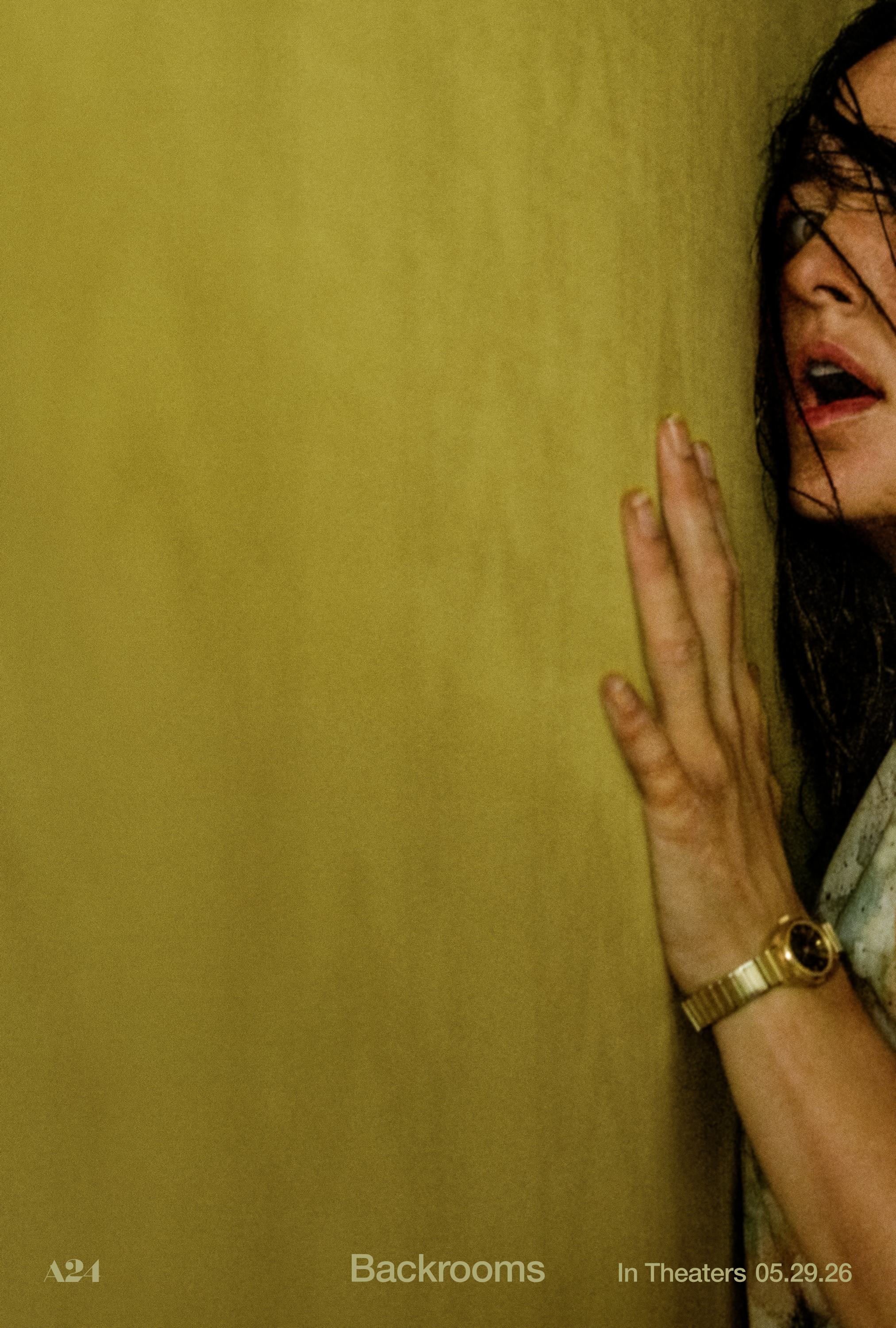
Backrooms did not break A24’s records so much as relocate them. Its $197.5M domestic is more than double Marty Supreme’s $96.0M, the label’s previous best, and Marty Supreme was itself $19M clear of Everything Everywhere All at Once’s $77.2M, so the old top of the A24 chart was already a step above everything under it. Put it the sharpest way: Backrooms’ opening weekend alone, $81.4M, is larger than the entire domestic run of every film A24 has ever released except one. The previous A24 opening-weekend record was Civil War’s $25.5M in 2024. This tripled it. And it is not just a specialty-label record. $81.4M is the fourth-biggest horror opening on record, behind only It ($123.4M), It: Chapter Two ($91.1M) and The Conjuring: Last Rites ($84.0M), all of them studio franchise plays.
All of that from an adaptation of a YouTube series, directed by a 20-year-old making his first feature, on a budget reported under $10 million and co-financed with Chernin. The B– CinemaScore capped the multiplier at 2.4x and kept it out of the $250M conversation, which is the only thing separating this from a top-five summer gross and is completely beside the point at that cost. And all of it landed two weeks into Obsession’s run, which means the two biggest independent-label results in years were playing the same market at the same time.

Toy Story 5
The most predictable win on this list and the one the season needed most. Toy Story 5 opened to $159.7M, a franchise record, and dragged the June 19–21 frame to $333.4M, the fourth-biggest June frame in our records. A 3.0x multiplier off an opening that size is a genuinely strong family hold, and it has carried the film to $477.9M domestic and $1.13 billion worldwide against a $250M budget.
The comparisons that matter are the two other legacy family franchises that opened in the same summer, because all three were asking the same question and got different answers. Minions & Monsters opened 65% below Minions: The Rise of Gru’s $107.0M and will finish roughly $190M below its $370.5M. Moana opened 24% below the 2016 original and 69% below Moana 2’s $139.7M, and will finish at just over a quarter of Moana 2’s $460.4M. Toy Story 5 opened 32% above Toy Story 4’s $120.9M and has already cleared its $434.0M final. Three legacy family franchises, one summer: two lost half their audience and one grew. And a fourth data point sits right next to it. Pixar also released Hoppers in March, $166.0M domestic and $389.7M worldwide on a $150M budget with an identical 94% Tomatometer. Same studio, same year, same reviews, roughly a third of the worldwide gross. Brand decides everything in animation, and only one brand held.

Twenty years after the original opened to $27.5M and finished at $124.7M, the sequel opened to nearly three times that and finished 77% higher. $692.0M worldwide on a $120M budget is the best margin on Disney’s entire summer slate, and it got there without any explosions. It is here rather than in the five only because the top of that list is so strong: we called $80–100M in our May preview with presales pointing at $100M+, and a $76.7M opening just under that range is still a terrific number for a comedy sequel arriving twenty years late.

The worst opening in the franchise’s history, barely a third of what Minions: The Rise of Gru managed, and then it legged 4.9x, the best multiplier of any wide release this summer other than Obsession. It has cleared half a billion worldwide on an $85M budget, so it is comfortably profitable. It is also the lowest the series has ever been, and Illumination will want a rebound from here. A strong result, just not the one they were planning on.

A franchise-record opening past the 2000 original’s $42.3M, followed by the franchise’s worst multiplier at 2.0x, which a C+ CinemaScore and 33% on the Tomatometer will do. None of it matters on a $30M budget. This returned nearly eight times its negative cost worldwide.
LosersThe five that cost the most
Those five are the season. These five are what it cost to get there: roughly $815 million of production budget before a dollar of marketing, against $900 million of worldwide gross. They are ranked by the size of the hole rather than the size of the budget, which is why the most expensive film on the list is only third, and the top two are close enough that we will make the case for both.
Supergirl
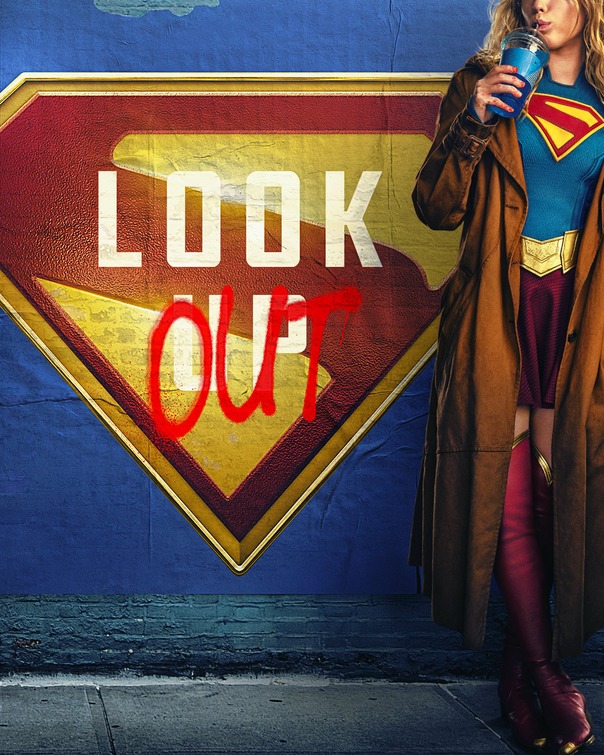
Call the top two a coin toss on the dollars. Supergirl takes the top spot for what it costs on top of them. Deadline reported a $170–186M net production cost, $120M in global P&A and a DC-record $100M promotional-partner campaign on top of that, putting breakeven around $315 million and the estimated loss near $125 million. Supergirl finished at $72.4M domestic and $126.4M worldwide. It did not clear its marketing budget.
A 58% Tomatometer and a B– CinemaScore off a $37.1M opening was only ever going to leg out at 2.0x, and it did. The bigger problem is the film standing in front of it. Superman opened to $125.0M last summer and finished at $354.2M domestic and $618.7M worldwide. Supergirl opened at 30% of that and finished at 20% of it. The second picture in the rebuilt DC slate kept a fifth of the audience the first one went out and found. Warner Bros. now has to sell the next one on Superman’s numbers and hope nobody looks at these.

Masters of the Universe
Here is the case for putting this first instead. A $170M production cost before a dollar of marketing, against $113.8M worldwide, is 0.67x of negative cost recovered at the global box office, worse than Supergirl’s 0.74x and far worse than Moana’s 1.23x. Every tentpole on this list lost money; this one got back the smallest share of what it spent. On percentages, it is the worst result of the summer.
We called it in our June long-range preview: we used Tron: Ares’ $73M domestic as the realistic finish and baked in a sub-$100M result. It landed at $64.8M. The reception was the surprise: a 73% Tomatometer, a 90% audience score and a B CinemaScore, which is a perfectly well-liked film. It simply had no audience waiting for it, a forty-year-old toy property with no theatrical track record dropped into a June frame where Scary Movie 6 took the top spot and Backrooms was in its second weekend. Amazon MGM made a good version of a movie nobody asked to see, at tentpole cost. That is a harder problem to fix than a bad movie.
What keeps it second rather than first is that the damage is contained. There is no franchise behind it to wound. A toy property that has never worked theatrically either lands on the first attempt or it doesn’t, and Amazon MGM can shelve the idea and never think about it again. The studio was not leaning on it either: Project Hail Mary opened in March, did $344.1M domestic and $684.1M worldwide and handed Amazon MGM the sixth-biggest film of the year before the summer had even started. Supergirl’s loss lands on a slate that has to keep building. This one lands on a slate that can simply stop.

Moana
The most expensive film on this list, and the one that turns a bad run into a real question about whether the live-action remake still works in 2026. It is not a dead format, and Lilo & Stitch did $1.038 billion worldwide fifteen months ago. But two of Disney’s last three have now missed badly: Snow White stopped at $87.2M domestic in 2025, and Moana cost $250 million with a reported $145 million of global marketing behind it, opened to $43.1M and has grossed $125.7M domestic and $308.1M worldwide. Deadline put the first-cycle loss at $100–125 million.
The number Burbank should be looking at is on the same property. Moana 2 did $460.4M domestic and $1.059 billion worldwide in November 2024. The live-action version made 29% of that worldwide, twenty months later, from an audience Disney had just finished proving was there. The format still prints money when the property is Lilo & Stitch. The question this result asks is whether it prints money on anything that isn’t already a sure thing.
It ranks third rather than first only because it recovered more of its cost than the two films above it. The reception split hard: 34% on the Tomatometer against a 90% audience score and an A– CinemaScore, which describes a movie the people who saw it liked and almost nobody chose to see. The 2.9x multiplier is actually respectable. The problem was never the hold. It was that the opening came in at less than half of what a $250M budget requires, and there is no version of this that gets to breakeven.

In the Grey
The smallest budget on this list, and it is fourth anyway because almost none of it came back. In the Grey is a Guy Ritchie action thriller with Henry Cavill and Jake Gyllenhaal that cost a reported $60 million, opened on 2,018 screens to $2.9 million, and finished at $5.7M. Its worldwide total is also $5.7M, because there is no international line at all. That is roughly ten cents back on the dollar of negative cost, before marketing.
The collapse was immediate and total: -68% in weekend two, then -92% in weekend three, at which point it was on 168 screens. A 47% Tomatometer with an 84% audience score and a B CinemaScore is not a disaster of a movie. It is a movie that no one was ever told about, released into the weakest frame of the entire summer. Every other film on this list at least got its opening weekend. This one never had one.

The Mandalorian & Grogu
The biggest May opening of the summer turned into the worst-performing Star Wars movie ever released. The Mandalorian & Grogu took $81.7M over Memorial Day weekend, a number that should have set up a $220M-plus domestic run, and then posted a 2.2x multiplier and stalled at $177.7M. Worldwide it stands at $345.7M against a $165M budget, below Solo’s $393.2M, which had been the franchise floor since 2018.
The audience score is fine (89%, A– CinemaScore) and the Tomatometer is not (63%), but neither explains a 2.2x leg on a family-rated Star Wars release in the summer. What explains it is that the opening weekend was the fanbase arriving at once and nobody arriving behind them. This was the first Star Wars film in theatres since The Rise of Skywalker in 2019, and after a seven-year gap the reintroduction sold exactly one weekend’s worth of curiosity.
It ranks last here because the dollar hole is the smallest on the list. A $165M negative against $345.7M worldwide is a loss in the tens of millions, not the hundreds. It is on the list at all because of what it means for Star Wars. This is the lowest-grossing film in the history of a franchise Disney bought for $4 billion, and it arrived under the best conditions a reintroduction could ask for: a seven-year absence to build appetite, the most popular characters of the streaming era, a family rating, Memorial Day weekend and an A– CinemaScore from the people who turned up. It converted all of that into one weekend. Every Star Wars film after this one now has to answer a question nobody thought was open: whether the theatrical audience for this franchise still exists at the scale Lucasfilm has been budgeting for. Some losses cost money. This one costs a plan.

It stays off the list proper only because it is ten days old. An original adult sci-fi thriller from the director of It Follows, with Anne Hathaway, Ewan McGregor and an 86% Tomatometer, opening to $21.0M is a genuinely good result, just not an $80–92 million one. Our model projects $50.2–58.2M domestic.

Will Gluck opened Anyone But You to $6.0M in December 2023 and rode word of mouth all the way to $88.3M, a 14.7x multiplier. He opened this one to $5.5M and it has managed $11.3M. Same director, same opening weekend, and the whole difference is what happened in week two.

It opened 66% above the 2021 film and more than doubled its $37.5M domestic, which in most years is a franchise successfully rebuilt. On an $80M negative and a 2.1x multiplier it is a wash at best, the summer’s clearest case of a sequel that grew and still did not grow enough.
Three good months, then two weeks that changed the season
May through August, and where the money actually landed.
May did $1.147 billion across five frames, up 8.5% year over year and the second-biggest May total in our records behind 2019’s $1.215B. June did $1.031 billion across four, up 23.8% and third behind 2018 and 2019. Between them they produced three of the five films above. What they did not produce was a single frame over $340M. The weakest week of the entire summer was the one Obsession opened into: $158.7M across the full Friday-to-Thursday frame of May 15–21, the only week all season under $180M. The Devil Wears Prada 2 opened the season on May 1 to $76.7M and legged to $220.6M domestic and $692.0M worldwide on a $120M budget, which is more worldwide than Supergirl, Masters of the Universe and The Mandalorian & Grogu made between them. June was the opposite problem: all five of its wide openers cleared $29M in their first weekend and only two held anything at all. It was a stretch that looked far better on Monday mornings than it did four weekends later.
July 2026 grossed $1.563 billion across five frames, the biggest single month in our 2017–2026 records, ahead of December 2017 ($1.470B) and June 2018 ($1.464B). It is also the most misleading number in this article. Through its first four frames July looked bleak and was way down on basically the last ten years, not including COVID. Minions & Monsters and Moana both opened inside that stretch and both under-delivered.
Then the last two weeks. The Odyssey pulled its July 17 frame to $306.1M and Spider-Man: Brand New Day pulled its July 31 frame to $637.4 million, the biggest single Friday–Thursday week we have ever charted, 19% above the Endgame week that had held the record since 2019. Those two frames are worth $943.5 million between them: more than the entire first four weeks of July, and 23.4% of the whole summer, out of fourteen days of release calendar.
August has been the same movie holding up the same month. The August 7 frame took $295.0 million, the biggest August frame in our records, past 2023’s $273M, and Spider-Man took 71.5% of that weekend’s top-twenty chart by itself, after taking 82.5% of its own opening frame. Those are the two most concentrated weekend charts of the summer, ahead of Toy Story 5’s 69.8% in June and The Odyssey’s 65.8% in July. Everything else has been counterprogramming with a very low ceiling, One Night Only at $11.3M and Super Troopers 3 at $6.9M, until August 14 put The End of Oak Street and PAW Patrol: The Dino Movie into the market for a $41.3M pair of debuts, split cleanly between the adult sci-fi lane and the family one.
Three groups took 75% of the summer
How the season split, then who won it and who paid for it.
Market shareHow the summer divided up
Counted by parent company, because that is where the money actually lands, Universal took 28.1% of the summer grosses, Disney 25.9% and Sony 21.3%. That is 75% of the season between three companies, with every other distributor in the business splitting the last $957 million.
Each releasing label is rolled up to its parent: Focus counts under Universal, 20th Century and Searchlight under Disney. Percentages are each group’s share of the $3.879 billion every summer release had grossed domestically through August 20.
The middle of the chart is where the interesting reading is. A24 and Warner Bros. are $18.9M apart, with A24 on top at $229.2M to $210.3M. Of course, for one of these studios, it was their biggest summer ever, while for the other, it was one of their worst. A24 got there with four releases and the biggest of them cost under $10 million, while Warner Bros. put four wide films into the market, three with large budgets, and took losses on all three of those.
WinnersWho actually won the summer
Universal
Sony has the biggest movie of the summer. Universal has the biggest summer, and it is not especially close once you count the way these companies actually book money. Folding in Focus, the group put $1.091 billion of domestic gross into the market from seven releases, more than any other studio group, with four films over $100M domestic and no two of them alike: The Odyssey at $512.8M, Obsession at $263.5M, Minions & Monsters at $180.8M and Disclosure Day at $116.6M. A three-hour Nolan epic, a $750,000 horror pickup, an animated sequel and an Amblin sci-fi thriller. Only One Night Only missed, and it cost $25M.
The underrated part is what the group did on the weekends nobody was watching. Universal won July 3 with Minions & Monsters and June 12 with Disclosure Day, the two softest frames on either side of Toy Story 5, and Focus won a May 15 frame that turned out to be the weakest of the entire summer. And there is a line on the ledger that never shows up in a market-share table: Universal Pictures International handles Michael overseas, which means the $649.1M of international gross on Lionsgate’s first billion-dollar film was moved through Universal’s pipes. Count that and Universal touched more of this summer than anyone.
Sony Pictures
Sony released three movies this summer and one of them is the biggest opening weekend in the history of the medium. The Spider-Man ledger is above; what it means for Sony is that a single title on a $225M negative accounted for 17.7% of every domestic dollar the market sold this summer and 21.3% of everything the summer sold. On raw scale, no studio had a bigger season.
It is second on this list rather than first because of what sits underneath it, which is nothing. The Breadwinner did $20.2M against a $25M budget and a 28% Tomatometer, and the rest of the slate is rounding error. $803.9M of Sony’s $825.6M, or 97%, is one movie. That is the best possible reason to win a summer and the least repeatable one, and it is worth being blunt about what it hides. Across all of 2026 Sony has released eight films for $1.055 billion domestic. Take Spider-Man out and that is $199.6M from seven releases, with GOAT’s $103.3M the only one of them above $30M.
A studio whose entire year swings on whether a Spider-Man film lands inside it is one slipped release date from a bad one, and Marvel Studios has the character back on screen often enough that Sony cannot count on this cadence. The next tier has to get built. Insidious: Out of the Further opened August 21 to $25.1M and is exactly the kind of release that needs to work: a cheap horror franchise entry that returns its cost several times over. Sony needs four or five of those a year, not one, or the summer it just won becomes the outlier it looks like.
A24
Fourteen years of A24 and the ceiling had always been the same: great movies, capped grosses. Backrooms broke all three of the company’s records at once, and the profit on a sub-$10M co-financed budget is larger than what most studios cleared on their tentpoles.
What makes it a studio story rather than a one-film story is the rest of the slate: The Invite platformed from a $704K debut to $25.1M and $38.4M worldwide behind it, which is a second profitable release out of the same summer with no marketing war chest attached. A24 outgrossed Warner Bros. this summer. That is the sentence.
LosersWho paid for it
Warner Bros.
Warner Bros. put four wide films into the summer market, more than Sony or Disney managed, and finished behind A24. Supergirl is the wound: a $37.1M opening, a 2.0x leg to $72.4M domestic and $126.4M worldwide against a $170–186M net production cost, $120M in global P&A and a DC-record $100M promotional-partner campaign, with Deadline putting the first-cycle loss at roughly $125 million against a $315M breakeven. Mortal Kombat II grossed $79.8M domestic on an $80M negative, which is a wash at best.
Evil Dead Burn ($32.2M on $20M) is the one clean win. And The End of Oak Street opened last weekend to $21.0M against a reported net cost of $80–92M, with our model calling $50.2–58.2M domestic. Good reviews on all of it: 86% for Oak Street, 72% for Evil Dead Burn. None of that changes the ledger.
Amazon MGM
Amazon MGM spent tentpole money twice and got mid-size returns both times. Masters of the Universe cost $170M before marketing and opened to $29.4M on its way to $64.8M domestic and $113.8M worldwide, and the film itself was received fine, with a 73% Tomatometer, a 90% audience score and a B CinemaScore, which is the frustrating part. It is not a movie people rejected; it is a movie nobody showed up for.
The Sheep Detectives is the better story and still not a good one: a 93% Tomatometer, an A– CinemaScore and a terrific 4.4x multiple off a $15.1M opening, which got it to $66.1M domestic and $132.3M worldwide on a $75M budget. Great movie, wrong budget. The studio’s season-saving title, Project Hail Mary, opened in March.
Disney
This is the contrarian entry, and it is contrarian because Disney had the biggest summer of anyone. Fold in 20th Century and Searchlight and the group put $1.007 billion of domestic gross into the market from five releases, 25.9% of the whole summer and second only to Universal. Two of them are unambiguous wins: Toy Story 5 at $1.12 billion worldwide, and The Devil Wears Prada 2, which opened the season on May 1 to $76.7M and turned a $120M budget into $220.6M domestic and $692.0M worldwide, the best margin on the entire Disney slate and the one release here nobody was worried about.
It is on this list for the other two. Moana cost $250M with a reported $145M of global marketing behind it and stands at $308.1M worldwide, with Deadline projecting a first-cycle loss of $100–125 million. The Mandalorian & Grogu took a $165M budget to $345.7M worldwide and is on track to be the lowest-grossing Star Wars film ever released. The arithmetic still works out. Toy Story 5 and The Devil Wears Prada 2 between them cleared more than enough to cover both holes and leave Disney comfortably ahead on the summer, which is exactly why the group finished a close second on the chart above. That is not why it is on this list. It is here because of which two divisions produced the holes: the live-action remake program and Lucasfilm, two of the pillars this company has built its theatrical decade on, both handed the same verdict by audiences inside ten weeks. A studio Disney’s size can absorb a couple of nine-figure write-downs in a year this good. What it cannot absorb is finding out in one summer that two of its most reliable machines have stopped turning, with Pixar carrying the slate and the margin coming from a studio it had to buy.
What the record actually comes down to
Three frames, and a coin flip that gets settled on Labor Day.
The all-time domestic summer record is 2013’s $4.755 billion, and summer 2026 has been running just behind that pace. $4.5 billion is locked. $5 billion is out of reach. The record is a coin flip, and it gets decided over Labor Day weekend.
We’re seeing the total gross landing between $4.74 and $4.80 billion, with the all-time record of $4.755 billion sitting almost exactly in the middle of our range. Either way, whether it gets there or not, here’s what we can celebrate: the market bounced back to pre-covid levels, a $750,000 horror movie with no stars took half a billion, we got the biggest R rated movie of all-time, and likely the biggest movie (of any rating) of all time domestically, and A24 more than doubled their previous biggest film of all-time. Whether the record falls or not, summer 2026 proved that moviegoing is alive and thriving... as long as you offer up stuff people want to see.